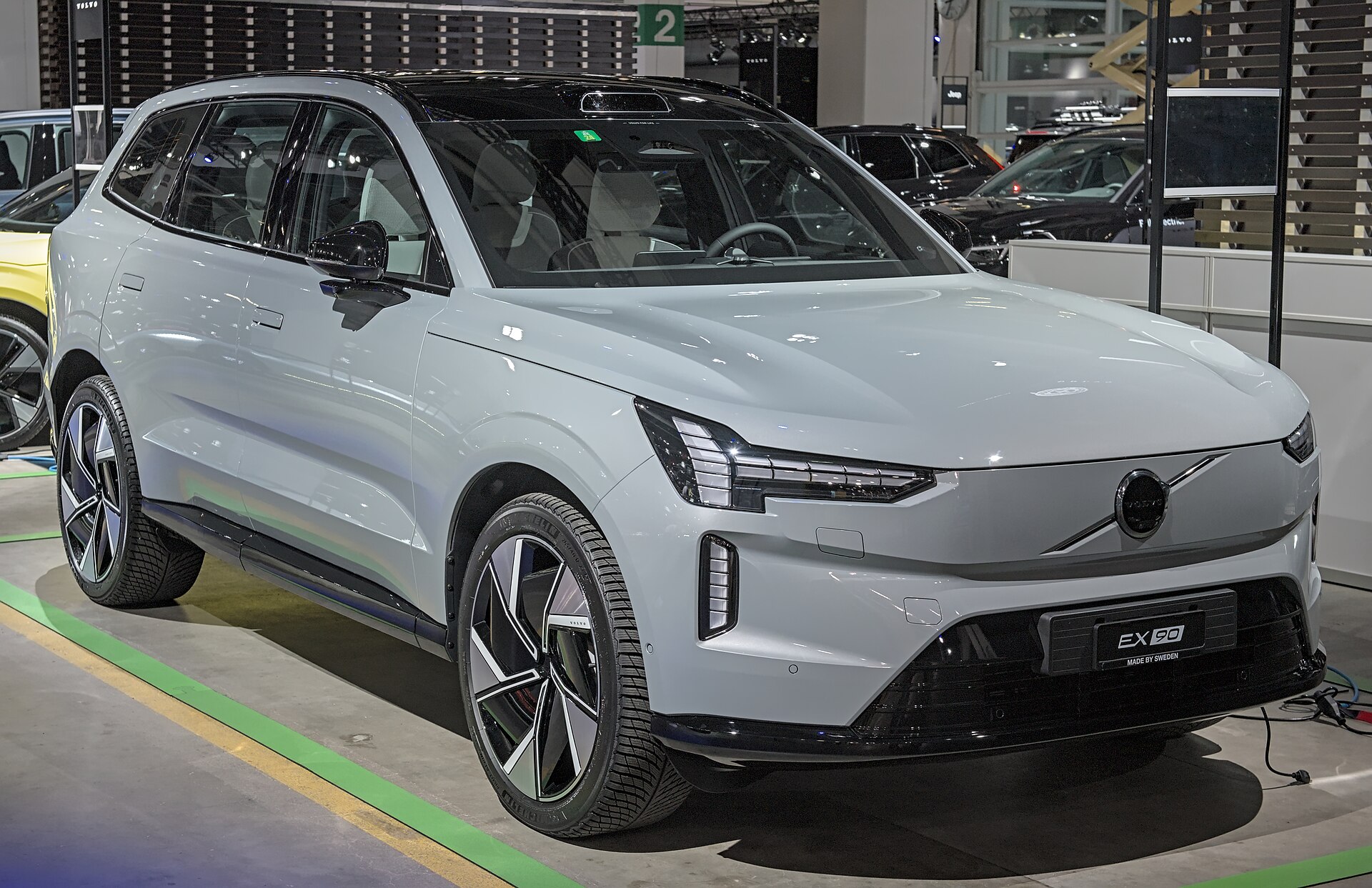
Unsplash / Wikimedia — contextual photograph; it does not show the announced software or future service behavior.
Volvo Brings Spatial Audio to CarPlay on the EX90
A Volvo software update adds Spatial Audio in Apple CarPlay to the EX90 and ES90, but only with the optional Bowers & Wilkins system. The change matters because the car, not the headphones, becomes the room Apple is trying to fill.
What Volvo switched on this week
Volvo has confirmed that Spatial Audio support in CarPlay, using Dolby Atmos, is now reaching the EX90 through a software update. The carmaker described the feature in a press release, and MacRumors reported the rollout on August 28. The condition is stated plainly in Volvo's own wording: the feature needs the Bowers & Wilkins premium sound system, which on the EX90 comprises 25 speakers. Volvo says that system can be selected when ordering the EX60, EX90 and ES90. The company first detailed Spatial Audio for those three models in July, and this week's update turns it on for the first of them.
A car is a difficult room to fill
Home cinema assumes a listener sitting more or less in the middle, in a room with a ceiling and walls that can be treated. A car assumes none of that. Seats are bolted in fixed positions, nobody sits at the acoustic centre, glass and hard plastic reflect sound in ways designers cannot move, and road, tyre and wind noise raise the floor of everything you hear. That is why the speaker count is not a marketing flourish. Height information, which a living room can get from a ceiling bounce, has to come from drivers physically mounted high in the pillars and headliner. Producing a stable image for a driver sitting off-centre, without wrecking it for the passenger, is the whole engineering problem — and it is why this feature ships with a specific audio package rather than as a software toggle.
"Spatial audio" describes two different things
The phrase is used for two distinct technologies, and the difference matters when deciding whether this feature is worth an option box. On AirPods, spatial audio usually means head-tracked spatialisation: the headphones use motion sensors to keep the sound anchored as the listener turns, and the effect can be applied to ordinary stereo as well as to Atmos mixes. In a car with fixed speakers there is no head tracking and no gyroscope. What is being delivered is playback of Dolby Atmos mixes across a multichannel array — closer to a cinema than to a pair of headphones. Neither is better than the other in the abstract, but they have different requirements. The car version depends entirely on the recording having been mixed in Atmos in the first place.
The requirement is hardware, and hardware is an option
"Rolling out via software update" is easy to misread. The update reaches every EX90 that receives it; the feature only becomes usable on cars that left the factory with the Bowers & Wilkins system. Owners who chose the standard audio package get the update and not the capability. For existing owners, the practical step is to check the original order or build sheet for the premium audio option before expecting anything to change. For anyone configuring one of the three models now, this is one more argument sitting behind an option that was already expensive.
What the iPhone side needs
The car supplies the speakers; the phone supplies the content. Getting anything out of this arrangement means playing material that was actually mixed in Dolby Atmos. Apple Music maintains the largest reachable catalogue of such mixes, and Volvo's description also mentions podcasts and live recordings. A stereo track played through the system remains a stereo track. Apple has not published a list of vehicles that support spatial audio through CarPlay, so buyers are left relying on carmakers' own statements — which arrive model by model, as this one did.
CarPlay as an argument, not just a feature
This lands in a specific competitive context. In January, Volvo publicly restated its commitment to CarPlay at a time when General Motors was removing it from some electric models. Audio features of this kind turn that commitment into something concrete: not merely "we still support CarPlay", but "CarPlay does something here it cannot do in a car that dropped it". We looked at another example of CarPlay's expanding role when ChatGPT arrived on the platform.
If a new Volvo is not on the shopping list
There is one route that does not involve buying a car. Pioneer released the first aftermarket CarPlay head unit capable of Dolby Atmos playback earlier this year, after showing it at CES in January. It brings the same capability to older vehicles, with the obvious caveats: the unit has to fit the dashboard, the installation is not trivial, and the existing speakers remain whatever they were. For most drivers, then, this remains a feature attached to a particular option on a particular set of new cars. It is a real improvement where it applies, and worth understanding precisely before assuming it applies.
The useful comparison is therefore not between a car and a pair of AirPods, but between a car with this option and the same car without it. The hardware determines how many independent sources can be placed around the cabin and how evenly the result survives a change of seat. The software can position objects in a mix, but it cannot create a missing speaker or remove the reflection from a windscreen. That is why Volvo's qualification matters more than the word “spatial”: it identifies a particular acoustic installation as part of the feature, even though the update itself is delivered over the air.