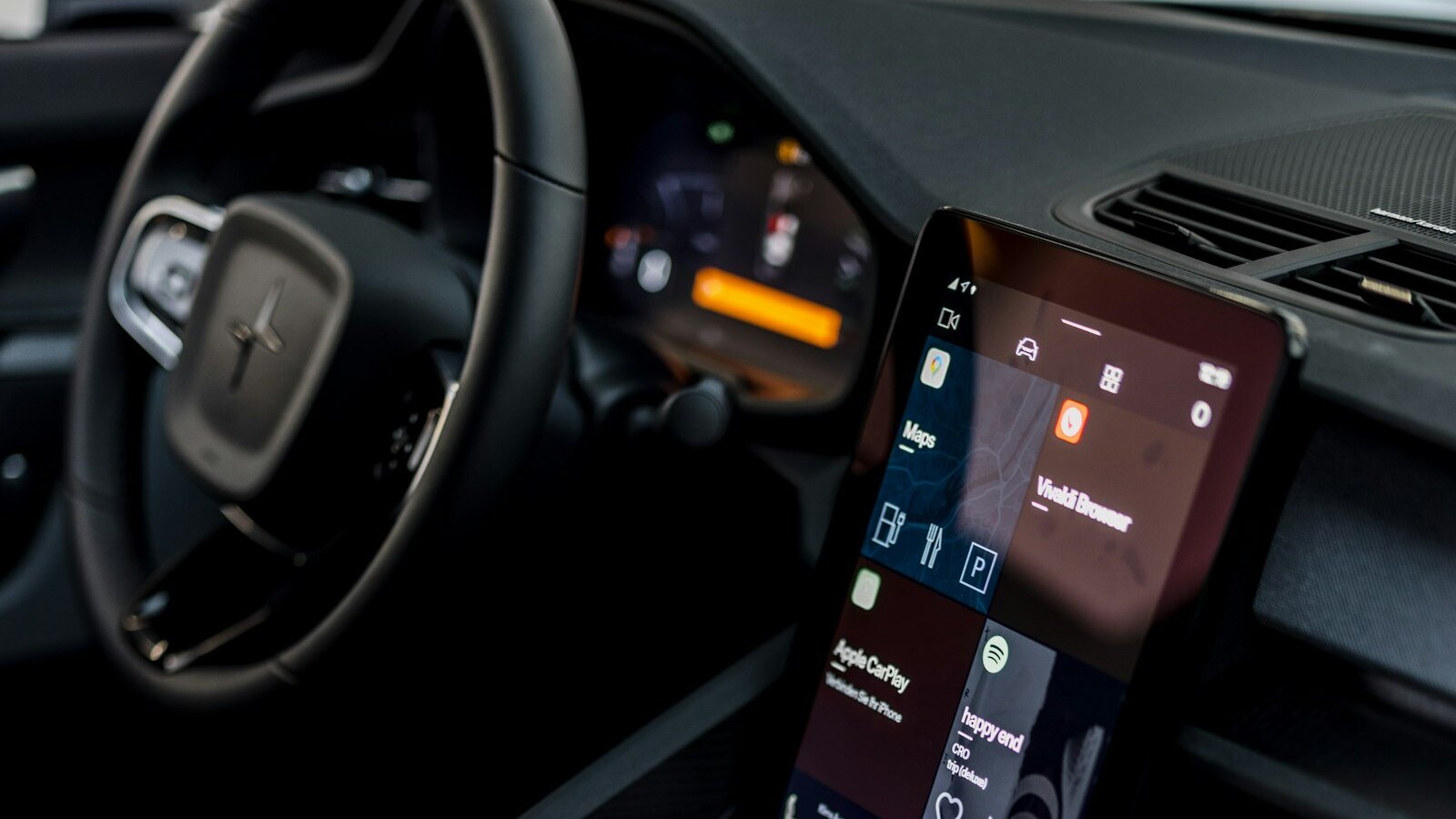
For years, CarPlay has been a reliable but conservative extension of the iPhone — maps, music, calls, and not much more. That era may now be coming to an end. With iOS 26.4, Apple has opened a new category of apps for the car dashboard: conversational AI assistants. And the first to arrive is none other than ChatGPT.
OpenAI's flagship chatbot, currently the most downloaded free app on the US App Store, is now fully integrated into CarPlay. The experience is voice-first by design: users can have spoken conversations with ChatGPT while keeping their eyes on the road. For safety reasons, the CarPlay version displays only conversation titles — no text walls, no image generation. The interface is stripped down to what matters behind the wheel.
This launch was made possible by a deliberate policy shift from Apple. Prior to iOS 26.4, third-party chatbots were locked out of CarPlay entirely. The update introduced a new app category — conversational voice apps — specifically designed for AI assistants. Apple opened a category rather than blessing a list of partners: ChatGPT arrived through OpenAI's own app, and Perplexity and Grok took the same route within weeks. No Apple announcement ever named which assistants would be allowed in.
CarPlay has always expanded by category rather than by exception, which is why the mechanism matters more than the three apps that arrived with it. Apple previewed the system as "iOS in the Car" in 2013 and shipped it in March 2014 with a deliberately short list of permitted app types: audio, messaging, calling. Third-party navigation, the single most requested addition, was not allowed until 2018 — four years in. Categories for parking, charging and food ordering followed at a similar pace.
The restraint in the ChatGPT implementation is a requirement rather than a stylistic choice. Apple's interface rules for the car are built around how long a driver may look away from the road, and they cap how much text an app may display, forbid video while the vehicle is moving, and push almost everything toward voice. Showing conversation titles and nothing else is simply what a chatbot looks like once those constraints are applied to it.
Assistants were not entirely absent from the dashboard before this. Amazon's Alexa app has been reachable through CarPlay for years by presenting itself as an audio app, and carmakers have shipped their own embedded voice systems alongside CarPlay for longer still. What changes with the new category is that an assistant no longer has to disguise itself as something else to earn a place on the screen.
Google Meet also made its CarPlay debut this week, rounding out a significant update for the platform. The video-calling app lets drivers join scheduled meetings with a single tap, view their upcoming calendar, and participate in audio-only calls — keeping attention focused on driving while staying connected. For professionals who spend time commuting, this integration could prove genuinely useful.
Audiomack, the music streaming service popular in hip-hop and R&B communities, completes the trio of new CarPlay arrivals. Its addition expands the music options available on the dashboard beyond Apple Music and Spotify, catering to a more diverse listener base.
The broader significance of this update lies in what it signals about Apple's vision for the car. By opening CarPlay to AI chatbots, Apple is acknowledging that the in-car assistant experience can no longer be limited to Siri alone. The move also puts pressure on the upcoming Siri redesign — expected at WWDC 2026 — to compete with conversational AI that users are already comfortable with in their pockets.
It also sits awkwardly against Apple's other in-car project. CarPlay Ultra, the deeper integration Apple previewed in 2022 and began shipping with its first partner in 2025, takes over instrument clusters and climate controls, but only in vehicles whose manufacturers agreed to rebuild their dashboards around it. Opening an app category changes the in-car experience for tens of millions of existing cars overnight; the deeper project changes it one model line at a time.
For carmakers, that asymmetry is uncomfortable. CarPlay is close to universal in new vehicles sold in the United States, and its popularity has long been the argument against automakers building their own software stacks — a few have tried to drop it and drawn complaints for doing so. A phone-side assistant that answers open questions and holds a conversation makes the embedded systems some manufacturers have invested heavily in look thinner still.
Drivers should treat this as an addition rather than a replacement. Siri continues to handle the system-level work — sending a message, starting navigation, controlling playback — while a chatbot handles the open-ended questions Siri has never been good at. Nothing in this update routes one to the other, and because the feature depends on the OpenAI app installed on the connected iPhone, it travels with the phone rather than living in the car.
For now, ChatGPT on CarPlay requires the standard OpenAI app to be installed on the connected iPhone, and conversations are not displayed as text within the car interface. Apple's approach prioritizes safety while still delivering a genuinely new capability. Whether drivers will embrace AI chatbots behind the wheel remains to be seen — but the door is now firmly open.