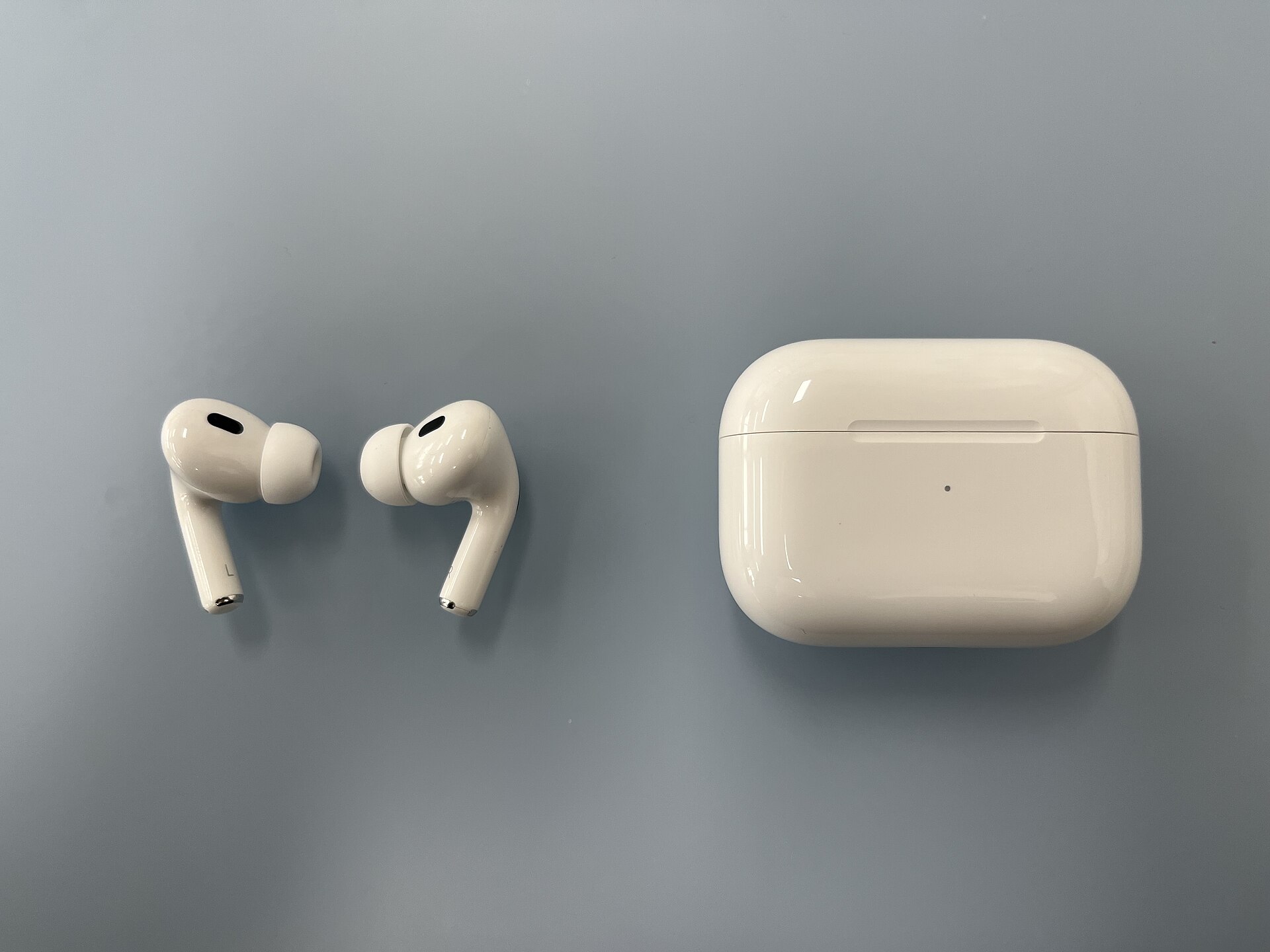
Sanju Pandita / Unsplash; contextual image, not camera-equipped AirPods
Tiny Stills, a Warning Light, No Video: Apple's Own Code Describes How Camera AirPods Would See
A hidden framework in the macOS Tahoe 26.7 release candidate describes how a rumored camera-equipped AirPods project could capture paired low-resolution stills, signal capture with a light and run person detection on the earbuds. Apple has announced no such product.
A hidden framework with a plain name
The findings build on the demo video MacRumors extracted from the same macOS release earlier this week. Forum member mactracker went further and located a framework called AccessorySensorManager, which handles sensor data flowing from AirPods to a connected Mac. Frameworks of this kind are plumbing, not marketing: they describe what the hardware must do, in the dry vocabulary of engineers who never expected outsiders to read it. That is precisely what makes the discovery informative — it documents design decisions, not promises.
Two cameras, one megapixel, and no shutter button
According to the code, each earbud carries its own camera sensor, and the pair returns synchronized color images with matching frame identifiers — the same scene from two angles, once per capture. The resolutions are deliberately modest. In an "active" mode, plausibly triggered by a Siri request, the earbuds sample a 640-by-640 image and return a processed 1024-by-1024 frame, a little over one megapixel. A "passive" mode works from 320-by-320 captures. The framework requests still images only; nothing in it describes video recording.
Those numbers are the most telling detail in the leak. A megapixel is far below what any camera intended for photography would offer in 2026 — the resolution says these cameras exist to feed Visual Intelligence, Apple's system for answering questions about your surroundings, not to take pictures you would ever look at. It is the difference between an eye and a camera: enough detail to recognize a scene, not enough to publish it.
Ears that glance around
The passive mode sketches how the earbuds might maintain awareness without being asked. The framework lists contextual conditions — nearby speech, changes in ambient audio, posture changes, head rotation, movement outside a defined area — under which the system can operate, with pairs of stills delivered continually at a specified rate. Whether each of those conditions triggers an actual capture is not spelled out in the code.
The engineering around that capture is substantial. The framework includes lens distortion correction, calibration between the two cameras, and calibration between the cameras and motion sensors, and it can reject frames ruined by excessive movement or a blocked view. Cameras mounted on a head that never stops moving are a harder problem than cameras in a phone held still, and the code shows Apple treating it as such.
Privacy answers written before the product exists
When Apple's camera AirPods first surfaced as a Siri companion earlier this month, the open question was how Apple would make always-available cameras socially acceptable. The framework contains at least three answers. Each earbud appears to have a hardware indicator light, with the system able to control its brightness remotely — a signal to bystanders that capture is happening, the same design logic that puts a mandatory LED on Meta's smart glasses. Detection of whether a person is in view runs as "peripheral inference," directly on the earbud rather than on the phone. And the tiny resolutions limit what the images could reveal even if intercepted.
None of this makes the product uncontroversial. A light can be covered, and passive capture triggered by ambient conditions is exactly the behavior that unsettles people about wearable cameras. But the code shows the privacy constraints were designed into the sensor pipeline from the start, not bolted on for the keynote.
A blueprint from a canceled model
One caveat reshapes the whole story. The AirPods shown in the demo video carry the codename B790 — a camera version of the AirPods Pro 3. Bloomberg's Mark Gurman has reported that Apple shelved that model and is now working on a newer generation, codenamed B798, targeted at 2027 and potentially timed to the iPhone's twentieth anniversary. The framework most likely describes the canceled device.
That does not make the findings worthless — it makes them a floor. Capture modes, stereo calibration and the indicator light are architectural choices that a successor would inherit or improve upon, and the fact that Apple built and filmed a working model shows how far the project advanced before being pushed back. But specific numbers, the 640-by-640 samples and one-megapixel outputs, describe hardware Apple has already decided not to ship.
Conclusion
Apple has announced nothing, and the earbuds described in macOS 26.7 may never reach a store. What the code offers is rarer than a rumor: a look at how Apple's engineers actually framed the problem of putting cameras on your ears — as low-resolution sensors with a warning light and on-device intelligence, not as a camera you happen to wear. Whether the 2027 product matches that framing is now the question worth watching.
MacRumors — Camera AirPods code reveals image capture resolution and privacy details
AppleInsider — AirPod cameras will detect people and warn about image capture
MacRumors — Apple's camera-equipped AirPods confirmed in macOS 26.7 video
MacRumors — Apple's camera AirPods not launching until 2027 despite leaked video
Macworld — Report: Apple aiming to launch camera-equipped AirPods this fall