
Apple Put Two Game Controllers in macOS 26.7, Then Took Them Back Out
The first release candidate of macOS 26.7 carried software profiles for two game controllers that identify themselves as Apple hardware, each with its own driver plug-in. The second release candidate no longer has them.
What was found, and where
Apple shipped the first release candidate of macOS 26.7 in mid-August, and it turned out to be unusually talkative: it named a dozen unreleased Apple devices, from iPhones and Macs to home accessories. We went through that haul at the time, including the kitchen screen buried in it.
A MacRumors forum member, Pdfu, has kept reading the same build and found something the first pass missed. Inside the GameController framework sit profiles for two devices, identified as T6502 and T1057, which declare themselves as Apple hardware. Both describe the full complement of a modern gamepad: a directional pad, two thumbsticks, shoulder buttons, analogue triggers, and Home and Menu buttons.
Two devices, one difference
The two are not copies of each other. Their haptic designs differ, and T1057 carries an accelerometer and a gyroscope that T6502 does not.
That gap is the most informative detail in the whole find. Motion sensors in a controller are what allow tilt steering and gyro aiming, the fine-adjustment technique that lets a player nudge a cursor or a reticle by moving the pad itself. A pair in which one model has them and the other does not looks less like a single product than like a tier: a standard model and a more capable one, or a controller and something that also has to work as a pointer.
Why the plug-ins matter more than the names
Codenames alone would prove very little. Operating systems are full of strings for hardware that never ships, and Apple's release candidates routinely carry scaffolding for products still years from a decision.
What raises the temperature here is that each of the two identifiers comes with its own hardware plug-in, the small piece of code that translates a specific device's electrical reality into the buttons and axes the system understands. Writing one is work, and it is work you do when a physical thing exists to be talked to. It is the difference between a name on a list and a driver.
Apple has been here before
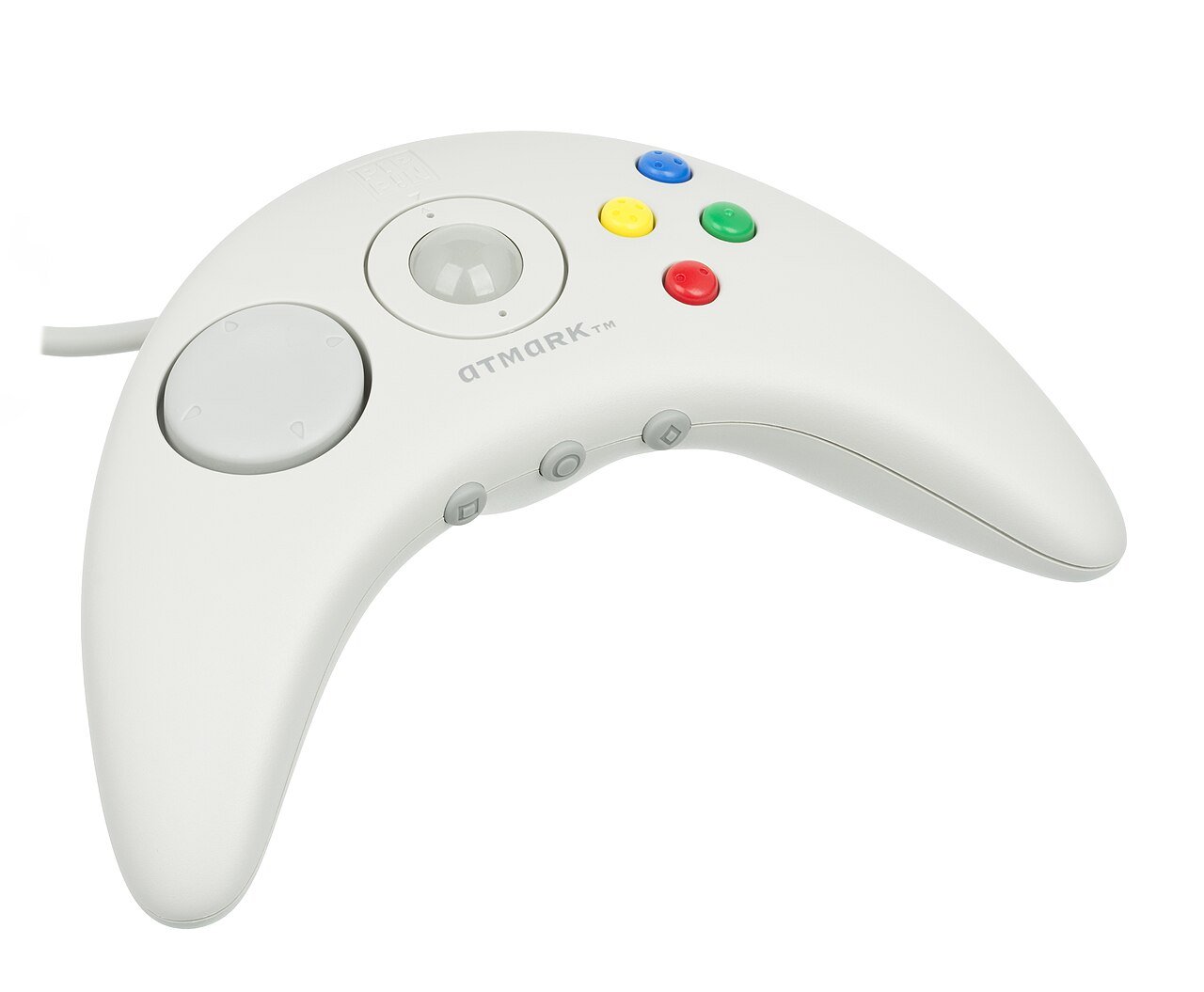
The idea of an Apple gamepad is not new; it has been circulating since at least 2012, and nothing has ever come of it. Apple has, in fact, shipped a controller once: the AppleJack, the boomerang-shaped pad that came with the Pippin, the console Apple designed with Bandai and released in 1996, and which vanished from shops almost as quickly as it had arrived. What has happened since is more instructive than the rumours.
In September 2015, Apple told developers that Apple TV games had to be playable with the Siri Remote. The rule lasted months. By June 2016 it was gone, because a thin rectangle with a touch surface is not a controller, and the games that had to pretend otherwise were worse for it. Apple's answer since has been to support everyone else's hardware extremely well: Xbox and PlayStation pads pair with iPhones, iPads, Macs and Apple TVs with no ceremony. When the Vision Pro needed proper controls, Apple did not design a controller either; it started selling Sony's PlayStation VR2 Sense controllers.
That is a company that has repeatedly examined this category and repeatedly declined it.
The code disappeared in the second release candidate
Apple removed the references before shipping the second macOS 26.7 release candidate. There is no way to tell from the outside whether that was housekeeping after an accidental disclosure or the normal removal of internal test scaffolding, and the two possibilities lead to opposite conclusions.
The alternative explanation deserves saying plainly: Apple needs reference hardware to test its own controller code, and reference hardware would look exactly like this in a system framework, Apple-signed, individually driven, never sold.
What would have to be true for this to ship
An Apple controller only makes sense as part of something larger. It would need games worth buying it for, which means an Apple TV powerful enough to run them, and Apple's console hardware has never been positioned that way. It would need to beat pads that most households already own, which is hard on ergonomics alone.
Where Apple could differentiate is in the parts nobody else controls: Find My on a device that lives under sofa cushions, instant pairing across every device signed into the same account, and no re-pairing dance when you move from the TV to the Mac. Those are platform advantages, not hardware ones.
For now, two identifiers appeared in one build and vanished from the next. The thing to watch is whether T6502 and T1057 turn up again in a later beta. Code that comes back is a product; code that does not was a test bench.
- MacRumors — macOS 26.7 Code Hints at Two Unreleased Apple Game Controllers
- MacRumors Forums — Apple is working on two unreleased game controllers
- MacRumors — macOS 26.7 references unreleased Apple devices
- MacRumors — Apple TV games must support the Apple TV remote (2015)
- MacRumors — Apple drops Siri Remote game controller demand (2016)
- MacRumors — Apple now sells PS VR2 Sense controllers (2025)
- MacRumors — Apple has worked on a physical game controller for iPhone (2012)
- blacktop/ipsw-diffs on GitHub