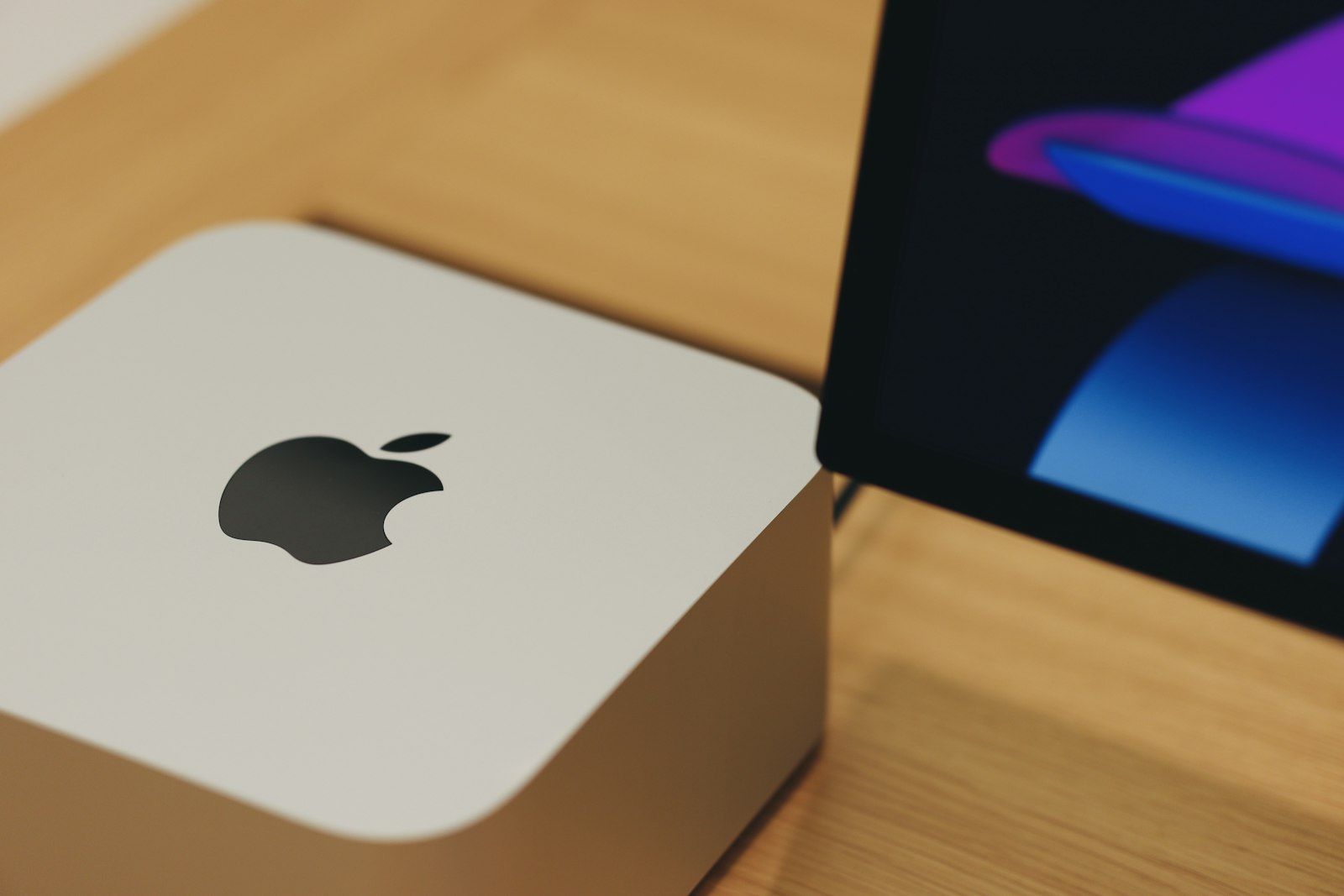
Unsplash — contextual photograph of the current-generation product
Apple Fused Four Dies Into One Mac Studio Chip. The Result Starts at $5,499.
The new Mac Studio pairs M5 Max with Apple’s first quad-die M5 Ultra. It can be configured with up to 512GB of unified memory, but that top option arrives only in late October and has no announced price.
What Apple announced
Apple introduced the new Mac Studio by press release on Tuesday, alongside the new Mac mini. Two configurations: M5 Max at $2,499 in the United States, $2,299 for education, and M5 Ultra at $5,499, $5,099 for education. Pre-orders opened the same day in 30 countries; deliveries begin on 22 September. The configuration with 512GB of unified memory is the exception — Apple says it will follow in late October.
Against the machine it replaces, Apple advertises up to 4.3× faster AI performance, up to 1.8× faster graphics, up to 2× faster storage and up to 1.3× faster CPU. The enclosure itself is untouched.
The quad-die trick, and why Apple builds chips this way
M5 Ultra is described by Apple as its most powerful chip ever, and it is the first M-series system on a chip to use a quad-die architecture. The construction is worth understanding. M5 Max is itself a dual-die part. M5 Ultra takes two of them and joins them with UltraFusion, Apple's die-to-die interconnect, which the company says now carries more than 4.4TB/s between dies with over six times the connection density of the previous generation. Four dies then behave, to software, as a single processor.
There is an economic reason for this design as well as an engineering one. Manufacturing yield falls as die area grows: a single enormous chip is far more likely to contain a fatal defect than two smaller ones stitched together. Building the top of the range out of repeated, proven blocks lets Apple sell an extremely large processor without betting the line on a single enormous piece of silicon. It is the same logic that has pushed the rest of the industry toward chiplets.
The result is an up-to-36-core CPU — twelve super cores and twenty-four performance cores — and a GPU of up to 80 cores, each carrying a Neural Accelerator.
The baseline is M3 Ultra, not M4
Apple's percentages for M5 Ultra are measured against M3 Ultra: up to 1.25× single-threaded, up to 1.3× multithreaded, up to 4.5× peak GPU compute for AI, and up to 40 percent faster graphics. M3 Ultra was the previous top of the range; no M4 Ultra was ever released. The comparison is therefore against a chip from the previous cycle rather than the previous year, which flatters the multiples without making them wrong.
The memory bandwidth figure follows the same rule: 1.2TB/s, which Apple presents as fifty percent more than M3 Ultra.
512GB is the number that changes what the machine can do
For running large models locally, memory capacity is usually the binding constraint before compute is. A model has to fit in memory to run at full speed at all; once it does, generation speed depends mainly on bandwidth. That is why 512GB of unified memory matters more here than any core count. It puts models with hundreds of billions of parameters inside a desktop enclosure — Apple says exactly that — without the model ever leaving the machine.
The practical consequence is privacy and cost rather than raw speed. A studio, a hospital, a law firm or a research group can keep a dataset and a model entirely on premises, with no per-token bill and no data leaving the building. Set against renting comparable memory in the cloud, a $5,499 desktop that also does colour grading starts to look like a different kind of purchase. The catch is the calendar: the 512GB configuration is the one that arrives in late October, not September.
Who is this actually for
Not many people, and Apple appears comfortable with that. The M5 Max at $2,499 remains the video and 3D machine — dedicated ProRes encode and decode engines, hardware AV1 decode, third-generation ray tracing. The M5 Ultra at $5,499 is aimed at workloads that were, until recently, assumed to require a server rack: frontier-scale inference, scientific simulation, very large scenes.
It also fits a broader pattern in Apple's silicon strategy, visible last week in [its move to a 2-nanometre process on the phone side](/en/2026-08-18-a20-pro-first-2nm-iphone-chip.html): push as much AI work as possible onto hardware the customer owns, and treat the cloud as a fallback rather than the default.
What is not in the announcement
Apple gave no independent benchmarks, no power figures under sustained AI load, and no pricing for the intermediate memory tiers beyond the entry configurations. Nor did it say when the 512GB option can be ordered rather than merely delivered. Those answers will arrive with the first reviews, after 22 September.