Unsplash — contextual photograph of the current-generation product
Apple's New Mac mini Starts at $899. The M6 Is Only Half the Story
Apple announced a redesigned silicon generation inside the familiar Mac mini on August 25: M6 or M5 Pro, faster local AI and a September 22 release. The entry price is $899, $300 above the original M4 launch price and $100 above the June price.
A launch by press release, four weeks ahead of delivery
There was no event. Apple published three press releases on Tuesday morning — one for the Mac mini, one for the Mac Studio, one for the chips inside them — and opened pre-orders in 30 countries the same day. Deliveries and retail availability begin on 22 September, almost a month later, which is an unusually long gap for a Mac.
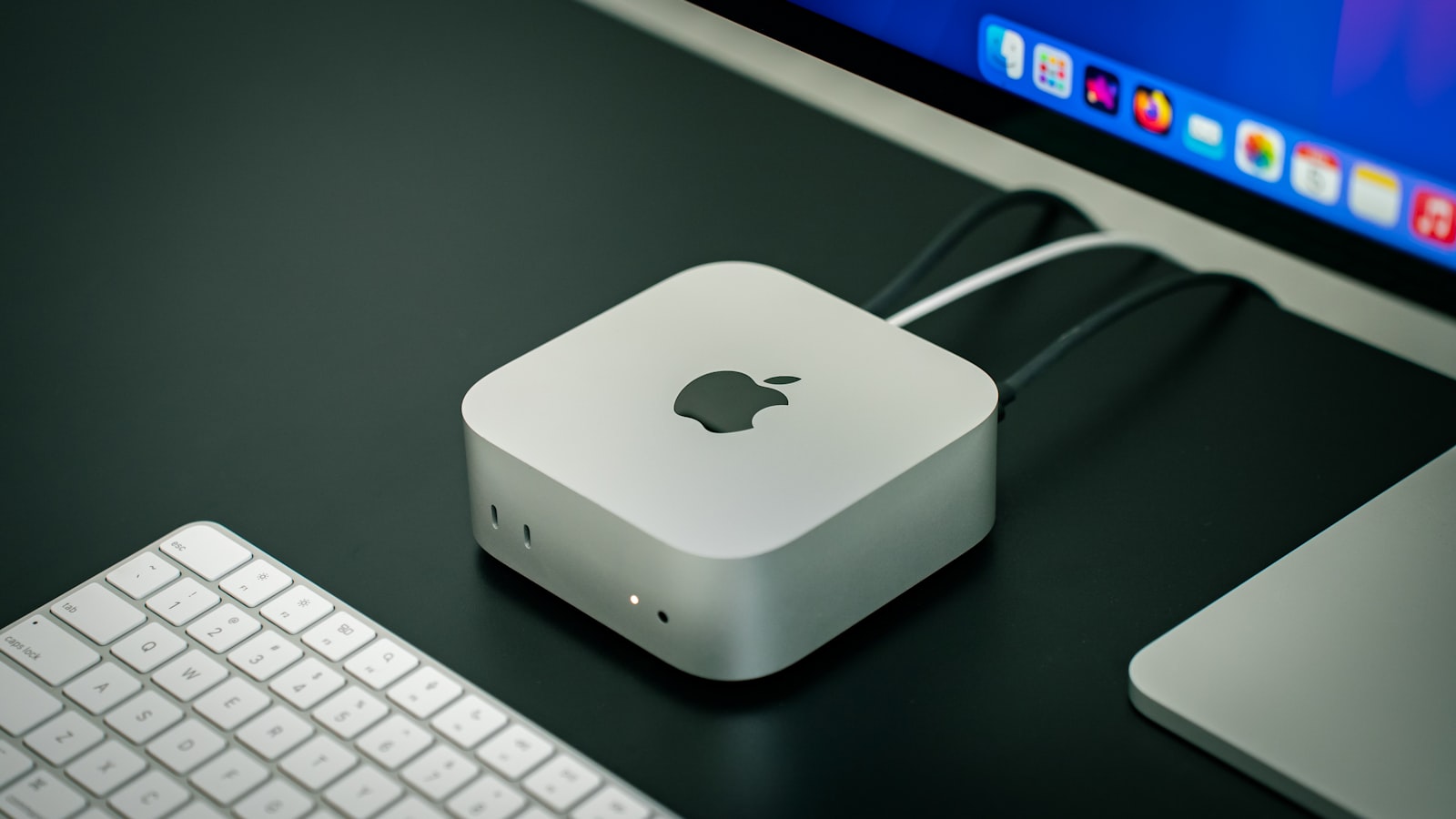
The enclosure is unchanged: the compact aluminium square introduced at the end of 2024 carries over, with two USB-C ports and a headphone jack on the front. Two configurations are offered. The M6 model starts at $899 in the United States, or $799 for education buyers. The M5 Pro model starts at $1,699, or $1,599 for education. AppleInsider reported that wait times on the outgoing M4 model had stretched to two months by Tuesday morning, which suggests the machine Apple is replacing was already selling faster than it could be built.
What is genuinely new inside M6
Apple's chip release describes M6 as its first 2-nanometre part, and the first M-series chip to mix three kinds of CPU core: two super cores, four performance cores and six efficiency cores, for twelve in total. The distinction matters in practice. Super cores are tuned for the bursty, single-threaded work that makes an interface feel quick — opening an app, scrolling a large document. Performance cores join them for sustained parallel work such as compiling or exporting video. Efficiency cores absorb indexing, backups and everything that should never spin up a fan. Apple claims the world's fastest single-threaded performance, 1.2× the multithreaded performance of M5 and 2.4× that of M1.
The GPU grows to twelve cores, each with a Neural Accelerator — a first on the entry-level Mac mini. Alongside it sits a new dual 16-core Neural Engine, and Apple says system frameworks can drive both engines at once. Unified memory starts at 16GB, tops out at 32GB, and runs at up to 170GB/s, against 153GB/s on M5 and 120GB/s on M4.
Why the bandwidth number matters more than it looks
Apple's headline figure is a 4.8× gain over M4 in LM Studio prompt processing. That is a real number, and it is also a narrow one. Running a language model locally involves two very different phases. Reading a prompt is compute-bound, and benefits directly from the new Neural Accelerators — this is where the large multiples come from. Generating the answer, token by token, is bound by how fast the model's weights can be streamed out of memory. That is the 170GB/s figure, and it is ten percent better than M5, not four times better.
Anyone buying a Mac mini to run models at home should read the two numbers separately: prompts will be handled much faster, answers will arrive somewhat faster.
The price line: $599, then $799, then $899
Macworld notes that the M4 Mac mini sold for $599 until June, when Apple raised prices across the Mac range in response to the memory shortage. The same shortage [pushed the MacBook Air up by $200 without solving its availability problem](/en/2026-08-09-macbook-air-memory-squeeze.html). The new entry price is therefore $100 above the model it directly replaces, and $300 — fifty percent — above where the line stood at the start of the summer. AppleInsider calls $899 the highest starting price a Mac mini has ever carried.
What that money buys at the base level has not moved: 16GB of memory and a 256GB SSD, neither of which can be upgraded after purchase, since Apple's unified memory is part of the package.
The M5 Pro model is a different proposition
The $1,699 configuration is not simply a faster mini. It starts at a 15-core CPU and 16-core GPU with 24GB of memory and 512GB of storage, and can be pushed to 18 and 20 cores for another $200, or to 64GB of memory with 307GB/s of bandwidth. It also carries three Thunderbolt 5 ports where the M6 model has three Thunderbolt 4.
That last difference is not cosmetic. Apple says Thunderbolt 5 allows several Mac mini units to be clustered together so that a single large model runs across them entirely on device. In Apple's own description, the machine built for serious local AI is the $1,699 one, not the $899 one.
Made in Houston, shipped under a new chief executive
Two pieces of context sit around this launch. Apple said in August that its new [Houston Advanced Manufacturing Center](/en/2026-08-13-houston-advanced-manufacturing-center.html) would begin producing Mac mini units this year. And Bloomberg's Mark Gurman, reported by MacRumors the day before the announcement, expected this Mac mini to be the last new product introduced while Tim Cook is chief executive; the handover to John Ternus takes effect on 1 September.