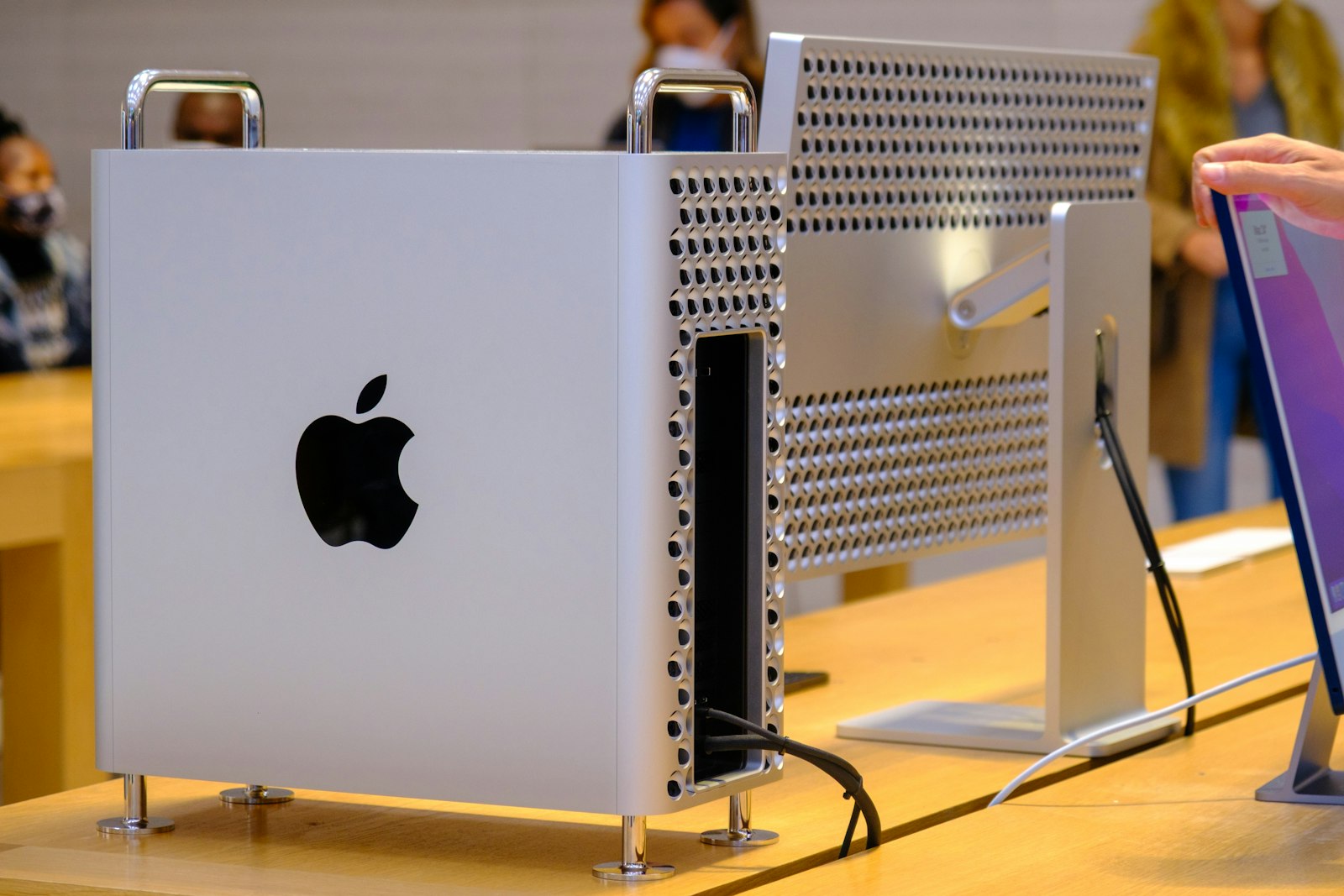
Apple Reportedly Tested Intel and M3 Ultra Mac Pro Models Before Ending the Line
A Bloomberg report describes two unreleased Mac Pro projects: an Intel-based J170 and an M3 Ultra J190. Neither shipped before Apple discontinued the tower.
Apple reportedly explored two more Mac Pro configurations before discontinuing the product line in March 2026. According to reporting by Bloomberg’s Mark Gurman, relayed by 9to5Mac and AppleInsider, the internal projects were known as J170 and J190. J170 used an Intel processor, while J190 paired the Mac Pro chassis with Apple’s M3 Ultra. Neither model reached customers.
The Intel project is notable, but the available reporting does not establish why Apple considered it. Bloomberg’s description only says it was intended to address certain uses. That is not enough evidence to attribute the decision to virtualization, software compatibility, PCIe graphics, or any other specific workload. Those possibilities remain speculation and should not be presented as Apple’s motive.
J190 followed the more predictable route. It was reportedly planned around the same period as the M3 Ultra Mac Studio introduced in early 2025. Its cancellation suggests that adopting Apple silicon alone was not sufficient to secure another Mac Pro release. In March 2026, Apple confirmed that the Mac Pro had been discontinued and that no future hardware was planned, leaving Mac Studio as its highest-performance desktop Mac.
The same report says Apple developed M2 Extreme and M3 Extreme chips above the Ultra tier, then wound down those projects because expected demand did not justify their cost. Apple has not publicly announced those chips, so they remain reported internal projects rather than confirmed products. Together, the abandoned machines and chips document paths Apple considered, not products buyers were ever promised.
The Mac Pro's history frames why these prototypes matter. The tower debuted in 2006 as the Intel-based successor to the Power Mac G5 and spent the following decade as the machine Apple pointed to whenever professionals questioned its commitment to high-end computing. The 2013 cylindrical redesign traded expansion for compactness and aged badly; the 2019 tower reversed course with a return to PCIe slots, user-swappable memory, and a frame built for heavy graphics hardware. That 2019 design, in updated form, is the one the line died in.
The Apple silicon transition set the clock ticking. Apple announced the move away from Intel at WWDC 2020 and completed it, symbolically, when the M2 Ultra Mac Pro arrived in June 2023. But that machine embodied the tension the prototypes hint at: it kept PCIe slots for specialized cards while dropping support for third-party graphics cards and user-installed memory, because Apple silicon integrates both onto the chip package. The result was a tower that cost considerably more than a Mac Studio built around the same chip, in exchange for expansion that ever fewer buyers needed.
That context explains the fascination with J170 without justifying conclusions about it. The things an Intel workstation can do that Apple silicon does not — discrete graphics cards, large amounts of user-installed memory, broad x86 compatibility — are well documented, and they are exactly the capabilities some professional niches never stopped asking for. It is tempting to connect those dots. But as the reporting stands, the dots are all we have, and Bloomberg's account does not say which of them, if any, motivated the project.
The chip story likewise follows a pattern that predates this report. Apple's Ultra-class processors are built by joining two Max dies with a high-speed interconnect, and rumors of a four-die "Extreme" tier circulated from the M1 generation onward. Bloomberg reported as far back as 2022 that Apple had shelved a quad-die chip because the economics of a low-volume halo processor did not work out. The reported fate of the M2 Extreme and M3 Extreme reads as the same calculation repeated: the engineering was feasible, but the market was too small to pay for it.
For working professionals, the practical landscape is now settled. Mac Studio tops the desktop line, and users who depend on PCIe cards are left with Thunderbolt expansion chassis, which accommodate audio, video capture, networking, and storage cards but not graphics hardware. Anyone whose workflow genuinely requires discrete GPUs or beyond-the-package memory has, in effect, been told the Mac is no longer aimed at them — a boundary Apple drew implicitly with the 2023 machine and made explicit in March.
What the report ultimately documents is a company testing exits before closing a door. Two decades after the first Mac Pro, Apple evidently examined both a step backward to Intel and one more push forward on Apple silicon, and concluded that neither produced a machine worth shipping. That is a more considered ending than a quiet discontinuation might suggest — and, for the tower's remaining devotees, perhaps a colder one.