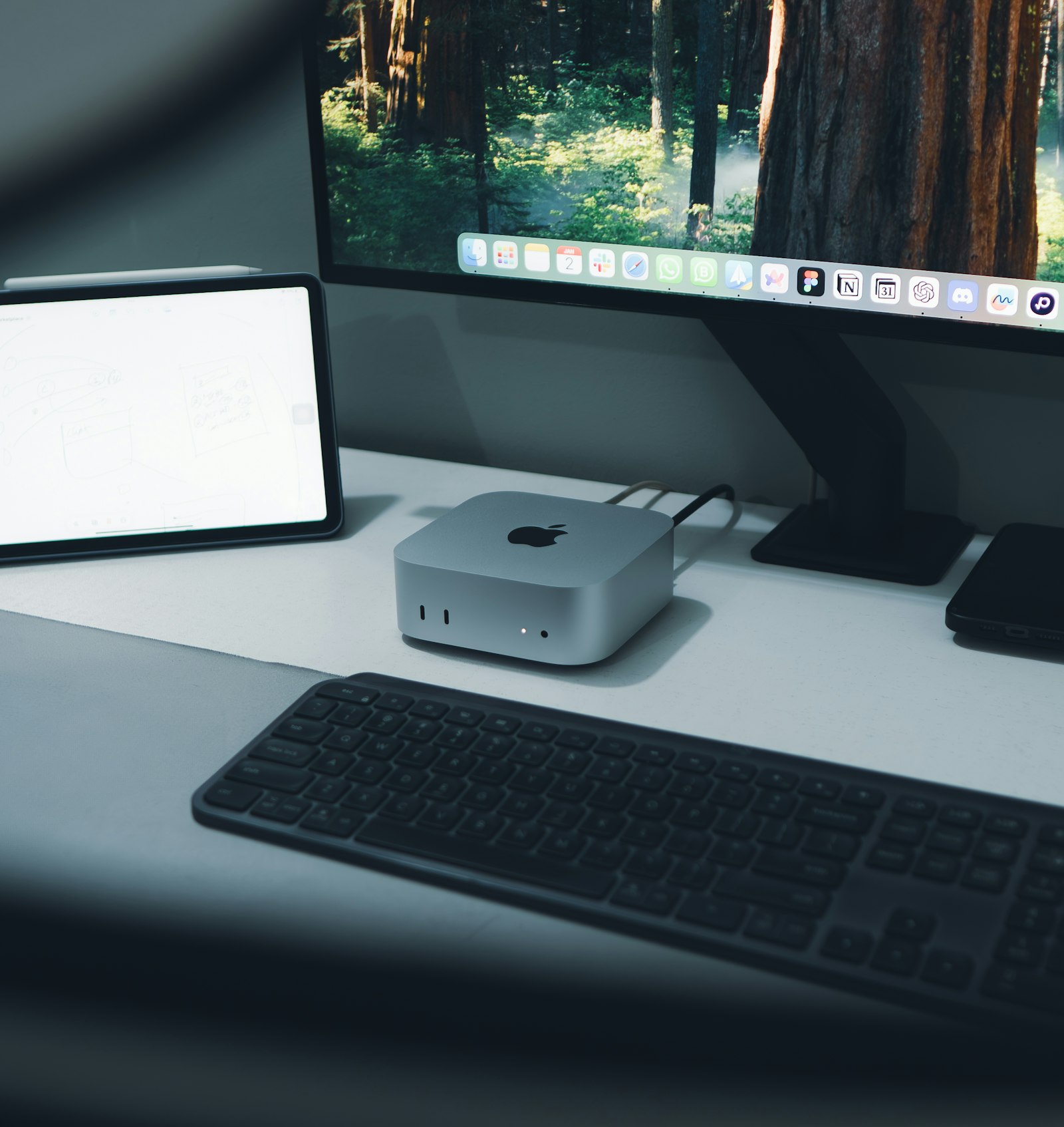
When Apple unveiled the MacBook Air M5 and MacBook Pro M5 Pro/M5 Max in March, it marked the beginning of the M5 generation — not the end. Several desktop Macs are still running previous-generation silicon, and all signs point to a wave of upgrades arriving in the coming months.
That staggering is normal. Apple's desktops have never moved in lockstep with its laptops, and they rarely move together with one another. The Mac Studio arrived in March 2022, took a new chip generation in mid-2023, and another in spring 2025. The Mac mini was rebuilt around M4 and M4 Pro in October 2024, in a far smaller chassis and at a lower entry price. The 24-inch iMac has tended to follow in the autumn. Three products, three rhythms.
The clearest next step in current reporting is the Mac Studio. AppleInsider, Macworld, and MacRumors have all pointed to refreshed desktop Macs after the spring MacBook cycle, with the Mac Studio consistently appearing near the front of the line. Early-2026 reporting often mentioned a midyear window, but the exact timing remains fluid and Apple has not confirmed any launch event.
The M5 Ultra remains the most attention-grabbing part of the rumor set because Apple never shipped an M4 Ultra in a commercial Mac. If the current reporting holds, the next Mac Studio would jump from M3 Ultra-class machines straight to an M5 Ultra generation.
There is a structural reason the Ultra tier is the hardest one to predict. Every Ultra chip Apple has shipped has been built by joining two Max dies with the UltraFusion interconnect it introduced in 2022, which means an Ultra can only exist if the corresponding Max die was designed with that connection in place. Apple has said before that not every generation will get an Ultra, and the 2025 Mac Studio bore that out by pairing a current-generation Max with a previous-generation Ultra in the same product.
Specific CPU and GPU counts remain speculative, so the safer takeaway is about positioning rather than exact numbers. The next high-end desktop chip is expected to target the same heavy creative and technical workloads as prior Ultra-class Macs, with more headroom for video, 3D, and local AI tasks.
What has quietly changed the Mac Studio's rationale is memory rather than cores. Because Apple silicon puts the CPU, GPU and RAM on a single package, the amount of unified memory a machine can be configured with sets a hard ceiling on the size of the model or the project that can be held in it at once. Ultra-class desktops have offered memory capacities no Apple laptop comes close to, which is why the Studio has become the machine people buy specifically to run large models locally.
The Mac mini is also in line for an M5 refresh. Reporting still places M5 and M5 Pro versions somewhere in the next phase of the desktop rollout, potentially alongside or shortly after the Mac Studio, even if the precise window is less settled than earlier rumors suggested. The compact desktop has become one of Apple's best-selling Macs thanks to its aggressive pricing and surprisingly capable performance, and an M5 update would further cement its position.
Its second audience is less visible. Since the 2024 redesign shrank it to roughly the footprint of an Apple TV, the mini has become a fixture in racks and cupboards: build servers, continuous-integration farms, hosted developer machines. That buyer cares about performance per watt and per liter rather than headline benchmarks, and replaces hardware on a fixed schedule regardless of the reviews.
An M5 iMac is also expected before the end of 2026, though its timeline is less certain. Some analysts suggest it could arrive alongside the Mac mini, while others place it later in the fall alongside new iPhones.
What remains unclear is the place of the Mac Pro in the same cycle. The strongest public reporting right now centers on Mac Studio and Mac mini, not on a new tower-class Mac Pro, so it is safer to treat the Mac Pro as out of focus rather than imminent.
The Mac Pro's difficulty is structural rather than a matter of scheduling. Since the transition to Apple silicon, the tower has offered PCIe expansion but the same chip and the same soldered unified memory as the Mac Studio, which left it with a narrow argument: buy it if you need cards, otherwise buy the smaller box. Unless Apple designs a desktop part a tower can actually exploit, another Mac Pro would mostly be a larger enclosure around a faster chip.
For anyone shopping now, the practical read is straightforward. Machines still on first- or second-generation Apple silicon are the ones with something material to gain, and their owners are the ones for whom waiting is worth the wait. A Mac mini bought in the past year or so will not be meaningfully outclassed by a mid-cycle refresh. And since Apple has confirmed none of this, the only firm date in the story is the one on the machine already sitting on the desk.
For now, the desktop M5 story looks staggered rather than fully mapped out. The laptops moved first, and the next concrete signs point to the rest of Apple’s desktop lineup taking shape in stages.