Apple Raised the MacBook Air's Price by $200. It Still Can't Keep Up.
Apple's most mainstream Mac is in short supply in the United States six weeks after a price increase — and the shortage began in the memory market that AI data centres have spent a year emptying.
Apple's best-selling Mac has become one of its hardest to buy. Six weeks after a $200 price increase, the MacBook Air is short of stock in the United States — and the reason has almost nothing to do with laptops. It starts in the memory market that artificial-intelligence data centres have spent the past year emptying.
A shortage Apple's own store staff say they have not seen before
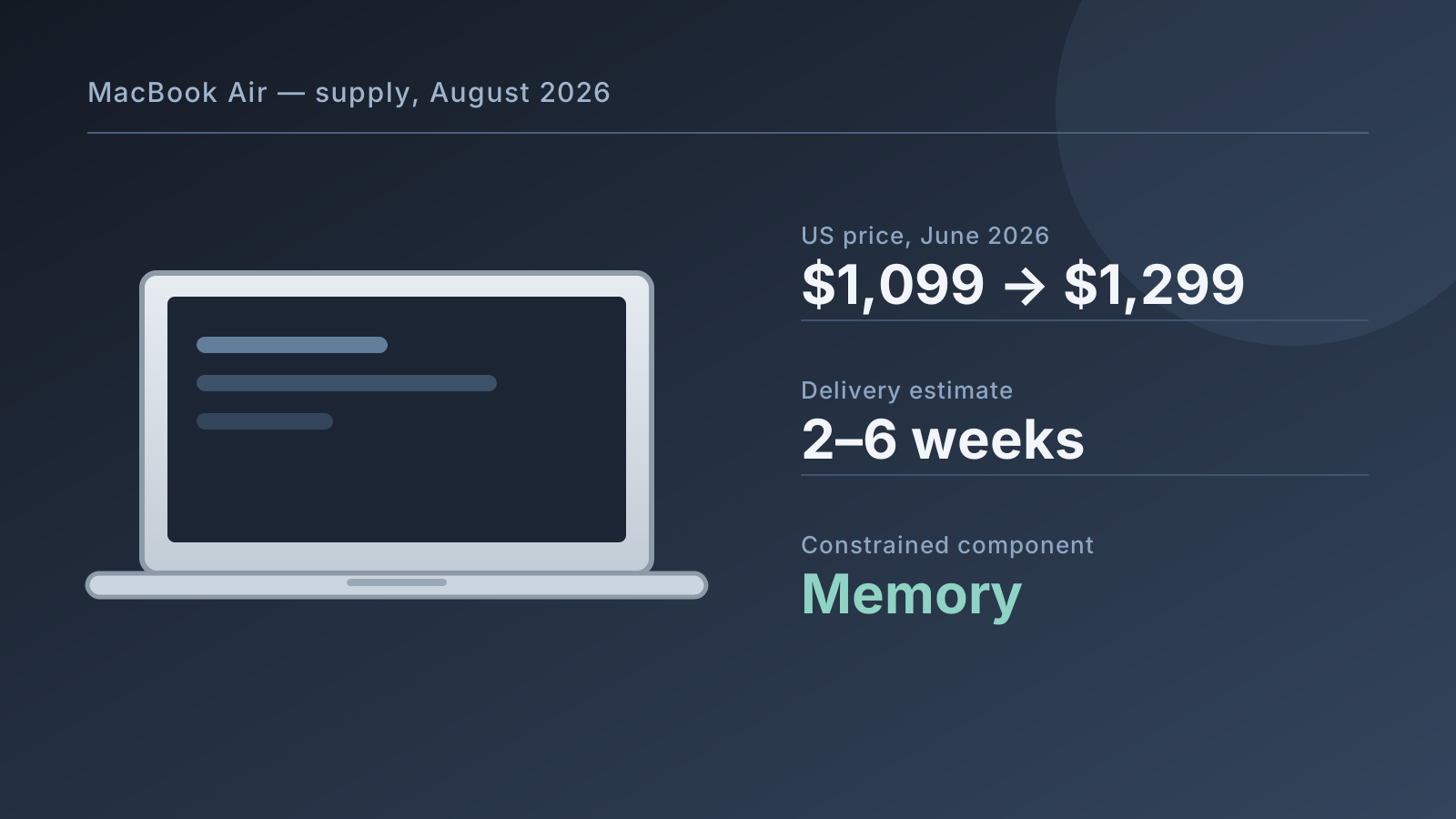
Bloomberg's Mark Gurman reported in his Power On newsletter on 2 August that the MacBook Air is experiencing a "major" shortage. Retail sources told him Apple is struggling to keep the laptop in stock, and that incoming shipments are more constrained than they can recall. On Apple's US online store, delivery estimates stretched from two to six weeks.
One detail in that report identifies the bottleneck more precisely than any supply-chain analysis: the configurations waiting longest are the ones with more RAM. A shortage of assembly capacity would delay every model equally. A shortage of enclosures would hit the 13-inch and 15-inch versions differently. When the delay scales with the amount of memory in the machine, the missing part is the memory itself.
Apple has not commented publicly on the delivery estimates. The Mac mini and the Mac Studio were affected before the Air, according to the same reporting — but those are niche machines. The Air is the one that sells in millions, which is why its turn is the one customers notice at the Apple Store counter.
Why memory, and why now
Memory chips are a commodity with a brutally cyclical price, and the current cycle is being driven by a buyer Apple cannot outbid on volume: the companies building AI data centres.
Training and serving large models is memory-bound long before it is compute-bound. A modern AI accelerator is paired with high-bandwidth memory — stacked DRAM dies sold at margins that ordinary laptop memory cannot approach. Fabrication capacity is broadly fungible: a wafer line converted to high-bandwidth stacks is a line no longer producing the LPDDR modules that go into a MacBook Air. The result is a squeeze that reaches consumer devices last, but reaches them.
Apple's own design choices make that squeeze harder to absorb. Apple silicon uses unified memory soldered onto the same package as the processor. There is no RAM slot, no possibility of shipping a machine now and fitting memory later, and no way to substitute a different supplier's module at the assembly line. Every capacity is a distinct product built to a distinct forecast. A 24 GB MacBook Air does not merely cost Apple more than a 16 GB one — it consumes fifty per cent more of the exact component that is scarce.
A $200 increase that did not clear the queue
In June, Apple raised prices on fourteen products. The MacBook Air went from $1,099 to $1,299 in the United States. Six weeks later, the supply is still constrained.
That sequence is worth pausing on, because a price increase is normally the fastest lever a company has for matching demand to available supply. Raise the price, and marginal buyers leave. Here that did not happen — or did not happen enough.
Two readings are possible, and they are not mutually exclusive. The first is that the increase was a pass-through of component cost rather than an attempt to ration demand: Apple was protecting a margin, not managing a queue. The second is that demand for a $1,299 Mac is less price-sensitive than the round number suggests, particularly among buyers replacing an ageing machine, and among the education and small-business customers for whom the Air is effectively the default laptop. Apple also pushed back its back-to-school promotion this year — a decision that reads differently once you know the shelves were going to be thin anyway.
The precedent, and what makes this one different
The industry has been here before. In 2017 and 2018, DRAM contract prices roughly doubled as smartphone makers and cloud providers competed for the same output, and every device category paid for it. That cycle resolved the ordinary way: high prices funded new capacity, capacity arrived, prices fell.
The difference this time is the identity of the competing buyer. In 2017 the rival bidders were other consumer-hardware companies operating on comparable margins. Today the rival is an industry whose customers accept costs that no laptop maker could pass on. When a memory supplier chooses between a contract for AI accelerators and a contract for consumer laptops, the arithmetic is not close. Apple is not being outmanoeuvred; it is being outbid, and so is every PC maker.
That framing matters for how long this lasts. Shortages caused by a factory fire or a logistics failure end when the fault is fixed. Shortages caused by a structural reallocation of capacity end only when new capacity is built — a process measured in years, not quarters.
If you are buying a Mac this month
Three practical points follow from the reporting, and none of them require a prediction about Apple's roadmap.
Order the configuration you actually need rather than the one you might grow into. This year, buying headroom costs money and time: the higher-memory builds are precisely the ones facing the longest waits.
Check the delivery estimate at the checkout stage, not on the product page. Estimates move by configuration and by region, and the figure attached to your exact build is the only one that describes your order.
If your timing is flexible and your current machine still works, note that Apple holds its main hardware event in September. Buying into a constrained supply of the current model, at a price that rose in June, is the least favourable moment in the cycle — unless you need the machine now, in which case the base configuration is the one most likely to arrive quickly.
What to watch next
Whether Apple broadens its memory sourcing, and whether the constraint spreads from the Mac line to the iPhone 18 generation launching in September, are the two questions that will determine how visible this becomes to ordinary buyers. Apple has not published guidance specific to memory supply. What is already established is narrower and clearer: the most mainstream Mac Apple sells costs $200 more than it did in May, and is harder to get than it was then. Both facts have the same cause, and it is not the laptop market.